
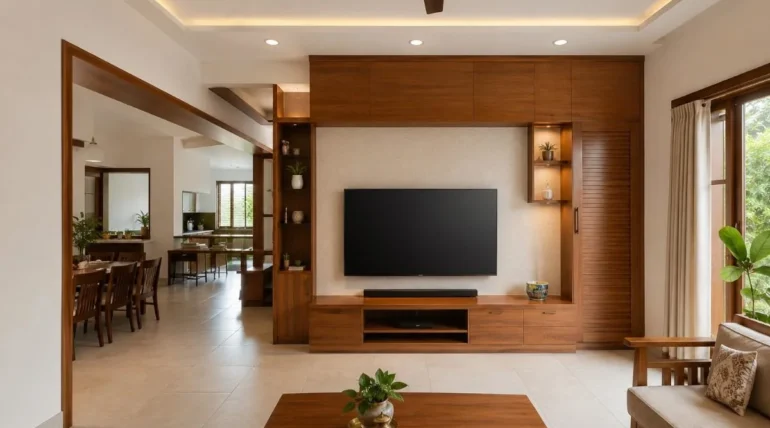
Kerala’s monsoon decides more about a home’s interior than any trend list does. Modern home interior design in this state has to survive nine feet of yearly rainfall, thick coastal humidity, and long stretches where windows stay shut for days. That reality is exactly why some trends catch on here while others quietly disappear after one wet season.
This year, the shift is less about chasing a look and more about choosing materials, layouts, and furniture that actually hold up in a Kerala household. Here is what’s genuinely changing and what’s on its way out.
Table of Contents
What Makes Modern Interior Design in Malappuram Best?
Modern interior design in Malappuram is seeing a clear move toward layouts planned around how a family actually uses a room, not just how it photographs. Open kitchens are giving way to semi-closed layouts that contain cooking smells and steam, especially in homes without strong exhaust systems. Storage is being built into walls and under staircases rather than added as an afterthought.
BNG Interiors, an interior design firm based in Malappuram, works this way by design. Every project starts with a 3D visualization stage before construction begins, so homeowners see the layout and can adjust it before anything is built. Because the company runs its own manufacturing facility, cabinetry and modular units are made in-house rather than outsourced, which keeps design and production under one roof.
A layout that looks good on paper still fails if the furniture inside it can’t handle the local climate. That’s where wood choice starts to matter more than most homeowners expect.
Wood Furniture Choices That Hold Up Indoors
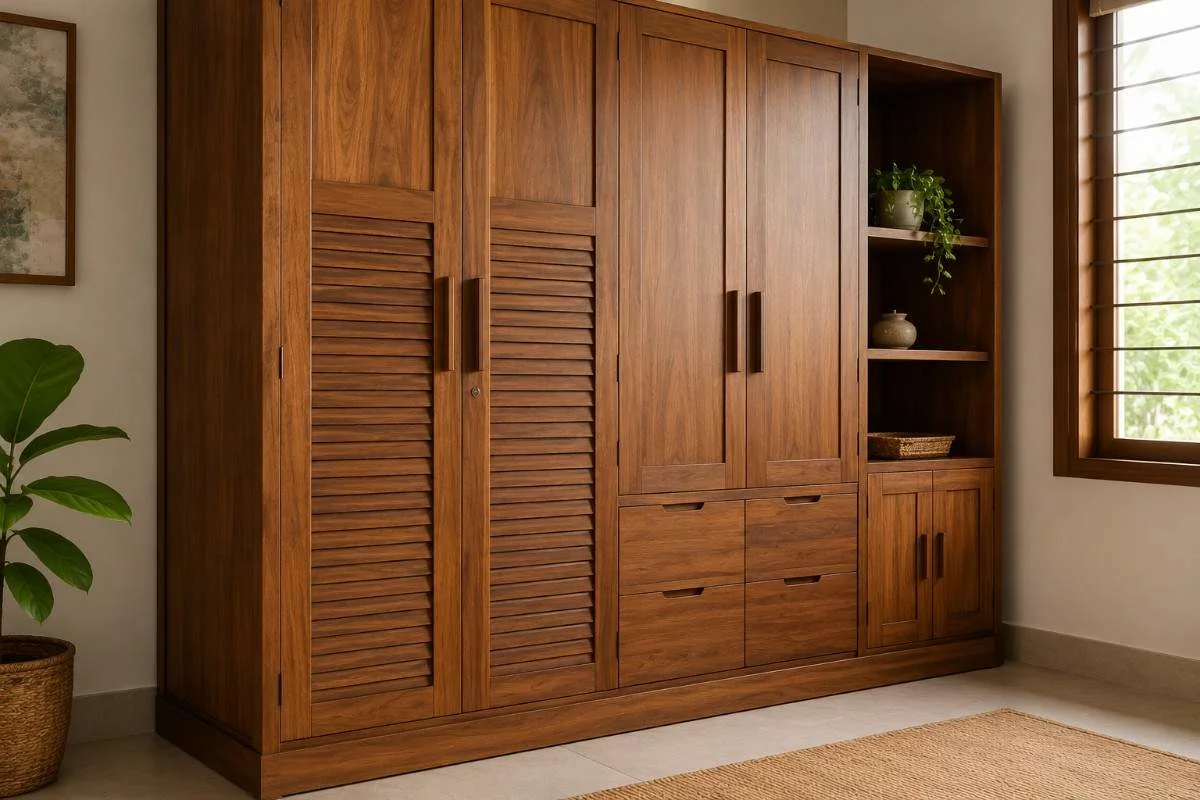
Solid wood is still the preferred material for wardrobes, beds, TV units, and cabinets across Kerala homes, but the finishing process matters as much as the wood species. Humidity causes wood to absorb moisture from the air and expand, and it releases that moisture and contracts when conditions dry out. Left unmanaged, this cycle causes joints to loosen, panels to warp, and drawers to stick within a year or two. The US Forest Service’s research on moisture relations in wood documents exactly why this happens and how finishing and construction methods reduce the effect.
Wood furniture manufacturers working in this region account for that from the start. BNG Interiors designs and finishes its furniture with Kerala’s humidity, heat, and building structure factored into the process, rather than applying a generic finish meant for a drier climate. Every piece, from wardrobes to TV units, comes out of the same in-house facility used for the interior fit-out, so the wood grade and finish stay consistent across a project.
Homeowners renovating this year are asking more direct questions about finish type and joint construction before signing off on furniture. That shift alone says something about where the market is heading.
Sofas and Seating Are Getting More Deliberate
The living room sofa used to be a late-stage purchase, picked off a showroom floor to fill a gap. That’s changing. Sofa manufacturers in Kerala are now starting most projects with a proper design consultation, working through size, fabric or leather, colour, and how the household actually uses the space before any frame is built.
At BNG Interiors, that consultation stage covers seating comfort, frame material, and finish before manufacturing starts, with a multi-point quality check on stitching and frame strength before delivery. The approach treats a sofa less like a catalogue item and more like a built piece of furniture, matched to a specific room and family.
Modern Home Interior Design: What's Fading Out
A few patterns are on their way out. Heavy false ceilings with multiple tiers are being replaced by simpler, single-level designs that cost less to maintain and don’t trap dust. Ornate, carved wooden panelling across entire walls has given way to cleaner surfaces with one or two accent pieces instead. Dark, closed-off rooms are also losing ground to layouts that let in more natural light, partly because Kerala’s climate rewards ventilation over enclosure.
None of this means minimalism has taken over completely. It means homeowners are choosing fewer, better-made pieces instead of filling a room with decoration that ages badly.
Getting the Details Right Before You Commit
The step that saves the most regret is also the simplest: seeing the design before committing to it. A 3D visualization stage lets a homeowner catch a layout problem, a colour mismatch, or a storage gap while it’s still just a drawing. Transparency around cost, materials, and timeline through the project matters just as much, since interior work in Kerala often spans several weeks of coordinated construction, manufacturing, and installation.
Final Thoughts
Modern home interior design in Kerala isn’t about following whatever trend is circulating online. It’s about layouts, wood, and furniture that hold their shape through a real monsoon and years of daily use. If you’re planning a renovation this year, start with the materials and the process, not just the mood board. What would change first in your home if you had to plan around durability before style?
FAQ
Timelines vary by scope, but a full home interior project, from design to installation, usually runs several weeks once materials are finalized. Projects with in-house manufacturing tend to move faster because cabinetry and furniture aren’t waiting on outside vendors. Ask for a realistic schedule before signing off on any project.
Yes, if the finishing and construction account for humidity. Solid wood expands and contracts as moisture levels change through the year, so unfinished or poorly finished pieces can warp within a season or two. Furniture designed with Kerala’s climate in mind, using proper joinery and finish, holds up far better than generic imports.
Not entirely, but the major decisions, layout, material, and budget, should be locked before construction begins. A 3D visualization stage lets you review the design and request changes on paper rather than mid-project, which saves both time and rework costs later on.
A custom sofa is built around your space, seating preferences, and fabric choice through a proper consultation. An off-the-shelf sofa is a fixed size and finished by someone else already decided on. Custom takes a little longer, but it fits the room and the household instead of just filling a gap.
It depends on the ceiling height and the room’s purpose. Simple, single-level false ceilings still work well for hiding wiring and adding subtle lighting. Heavy, multi-tier designs are less common now since they collect dust and cost more to maintain without adding much functional value.