
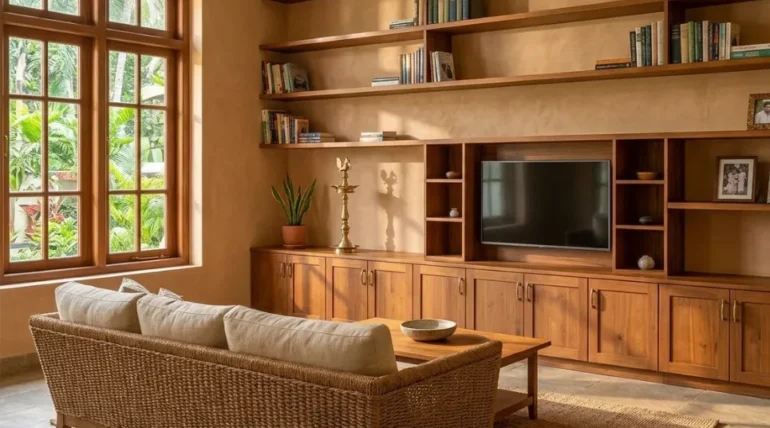
Most living rooms share the same quiet problem. There’s one blank wall nobody knows what to do with and a pile of things with nowhere to go. Remotes and chargers. That wedding album your aunt keeps asking about. Many homeowners end up solving both at once with shelving, because well-planned wall decor for living room spaces can hold your everyday stuff and still look like it was meant to be there.
Here’s how to plan one, and what to check before picking materials for our weather.
Table of Contents
Why Does One Wall Can Handle Storage and Display?
A bare wall is easy to maintain. It also does nothing for you.
Shelving changes that. Open shelves give your favorite pieces a place to be seen, while closed cabinets underneath swallow the clutter you’d rather hide. Most families need a bit of both, and the ratio depends on how the room actually gets used.
That’s where space planning comes in. Good interior design in Malappuram and across Kerala tends to start with daily habits and budget before anyone talks about colors or finishes. The aim is to make use of every available bit of space, so a shelving wall gets planned around your life from day one. Squeezing it in at the end rarely works.
Planning Wall Decor for Living Room Shelving Around Daily Use
Start With What You Own
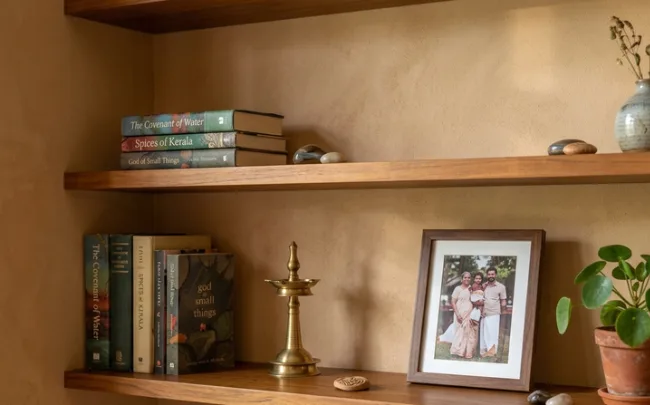
Before sketching anything, take stock. Books need sturdy, continuous shelves. Brass lamps and family photos need breathing room. Board games and files belong behind doors.
Write the list down. It sounds tedious, but it stops you from building a beautiful unit that fits none of your things.
Mix Open and Closed Sections
Here’s a pattern many designers lean on: closed storage near the floor, open display higher up. Lower cabinets hide what kids and guests tend to grab. Upper shelves stay at eye level, where decor gets noticed.
You don’t have to follow it strictly. Some rooms suit a single floating shelf. Others work better with a full wall of cabinetry and only two or three open niches.
Plan Around the TV Wall
In many Kerala homes, the TV wall is the natural spot. A TV unit with built-in shelving on either side can hold set-top boxes and cables out of sight, with display space above.
Choosing Wood That Suits Kerala's Climate
Our humidity and heat are hard on furniture. Wood naturally takes on and releases moisture with the air around it, which may cause swelling or warping over time if the finish and construction aren’t suited to local conditions.
So when you speak with wood furniture manufacturers, ask a few direct questions:
- How do they account for humidity in the finishing and the construction, given Kerala’s climate and typical house structure?
- Do they build in their own workshop or outsource it?
That last one matters more than people expect. A maker with its own manufacturing facility usually has more direct control over material quality and finishing at each stage and can often produce custom designs more accurately.
See the Design Before It's Built
Shelving is hard to imagine from a floor plan. Proportions that look fine on paper can feel heavy once they’re on your wall.
Some designers now offer 3D visualization before a project begins. This lets you see how the finished wall might look and request changes while edits are still cheap. For built-in units, that preview can save a lot of second-guessing.
A Quick Note on Safety
Wall-mounted shelves carry real weight, especially once books go on them. How much a wall can safely hold depends on how it was built. The fixings and the way weight is spread across the shelf matter as well.
Tall standalone units can tip if they aren’t anchored, which is a particular concern in homes with young children.
This article shares general design information only. For load-bearing shelves or heavy cabinetry, please have a qualified carpenter or structural professional assess your wall on site before installation.
Styling Shelves So They Don't Look Cluttered
Once the unit is up, restraint helps. The most pleasing wall decor for living room shelving often looks slightly underfilled on purpose.
A few habits that tend to work:
- Leave some shelf space empty. Gaps let individual pieces stand out.
- Group small items in odd numbers and vary their heights.
- Repeat one color or material across different shelves so the wall reads as a whole.
And step back after you arrange things. Then remove one more item. Seriously.
Wall color matters too. A warm neutral behind wooden shelves can make both look richer.
Final Thoughts
A shelving wall works best when it’s planned around how you live. Know what you’re storing before you draw a single line. Then pick wood and finishes that can handle Kerala’s humidity. If you can see the design in 3D first, even better. The decor part tends to follow once the basics are right.
If you’d like to look at real examples of custom shelving and wood furniture in Kerala homes, BNG Interiors shares project work and design references worth browsing.
So, what’s sitting on your blank wall right now, and what would you put there if it had shelves?
FAQ
They can. The finish and the way the unit is built make most of the difference, so ask the maker how they handle moisture before you order.
Honestly? Probably both. Keep the stuff you’d rather not dust or look at behind doors, and leave a few open spots for things you actually like seeing every day.
Sometimes, but it really depends on your wall and the fixings. Get a carpenter to check it first. Tall units should be anchored too, especially if you’ve got small kids running around.
Put less on them. Leave gaps.
Many designers offer a 3D preview now. Ask for one before any work starts, since changes cost far less at that stage.