
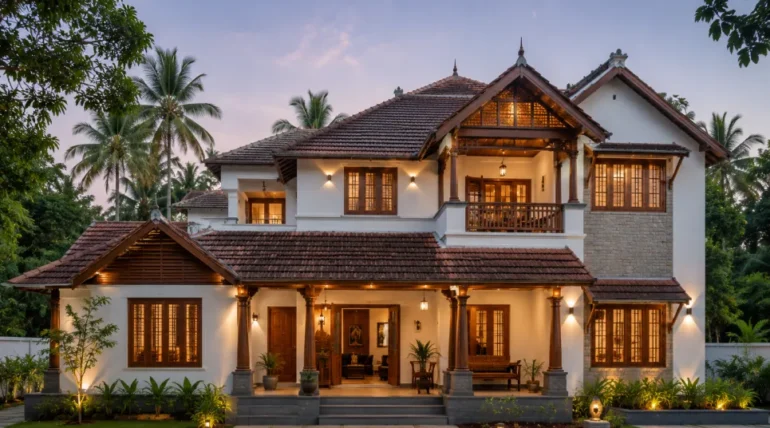
There is something about a traditional Kerala home that pulls you in. The cool shade under a wide sloped roof. The smell of aged teak. A central courtyard open to the sky. These are not just design choices. They are a way of living that families here have understood for centuries. The problem is, modern homes built across Kerala today often lose all of that. Flat roofs. Bare walls. Rooms that feel sealed off from the outdoors. And at the end of it, homeowners find themselves wondering why the house does not feel like home. The good news is that Kerala style home design does not ask you to choose between the old and the new. It asks you to be smarter about blending them.
If you want expert guidance tailored to your space, the interior designing services at BNG Interiors cover this kind of customised planning from concept to completion.
Table of Contents
What Does Actually Make Kerala Architecture Work?
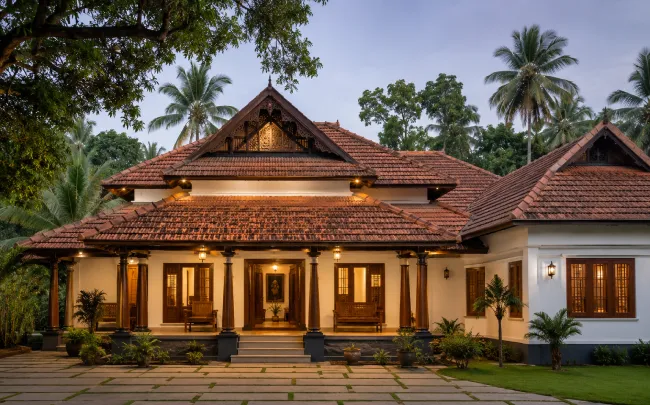
The traditional Kerala home, at its core, was built around climate logic. The nalukettu, a four-sided structure arranged around an open central courtyard called the nadumuttam, was not just beautiful. It was a natural ventilation system. Rain came in through the top and drained out below. Breeze moved through the space freely. Light filtered without direct sun hitting the interiors.
When you bring this thinking into a modern home, you are not copying an old building. You are copying an old idea. And old ideas that worked tend to keep working.
How to Work Sloped Roofs Into a Contemporary Layout
The sloped roof is probably the most recognizable element of Kerala’s built heritage. Mangalore tiles, red oxide finishes underneath, and wide overhanging eaves that keep walls dry through monsoon months. All of this has practical roots.
In a modern layout, sloped roofing works well over the main living area, the entrance porch, or a covered outdoor sit-out space. You do not need to slope every surface. Partial sloped roofing combined with a flat roof over service areas like the kitchen or utility zones is a combination that many architects working on Kerala homes today find effective.
The eave overhang is worth keeping generous, at least two feet out. It protects the external walls from Kerala’s heavy rain and also creates shade that reduces cooling loads inside.
Wood in Modern Interiors Without the Antique Look
Kerala’s relationship with wood runs deep. Teak, rosewood, and jackwood. Traditional homes used wood for doors, window frames, ceiling panels, columns, and railings. The joinery was fine; the detailing was elaborate.
Today, you do not need to replicate that entirely. The goal is to carry the warmth of wood into a contemporary interior without making the whole space feel like a heritage museum.
A few practical ways to do this: use solid wood for the main door and main staircase, since these are high-visibility points that reward quality material. For interior wall cladding, wood paneling in straight horizontal runs reads as modern while still feeling warm. Ceiling treatment using wooden planks in the main living area brings that courtyard-house feeling without touching the rest of the layout.
The interior designers in Malappuram at BNG Interiors often work with clients to find the right balance between wood density and open space. Too much wood makes a room feel heavy. Too little and the design loses the character it was meant to carry.
The Courtyard Question
Not everyone building today has the land or budget to include a full nalukettu courtyard. But the concept scales. A small interior skylight, even two by two meters, can bring natural light and a sense of vertical openness into a compact home. Some homes use glazed roofing above stairwells to achieve a similar effect.
Landscape elements placed at key sight lines from indoor spaces can substitute some of the visual connection to nature that the traditional courtyard provided.
Colors, Surfaces, and Details
Kerala style does not mean the entire interior should be dark wood and red floors. The traditional palette actually used whitewashed walls, red oxide or stone floors, and the natural color of wood as contrast. That combination remains relevant.
In modern interpretations, warm whites and off-whites on walls, with natural stone or polished cement floors, sit well alongside wooden elements. Brass fixtures, terracotta accents, and woven textures in soft furnishings all pull from the regional material language without forcing the design backward in time.
Final Thoughts on Kerala Style Home Design
Kerala’s traditional architecture survived centuries because it solved real problems. Humidity, heat, monsoon rain, and the need for community space were all accounted for in the nalukettu form. When those same principles inform a modern floor plan, the result is a home that works as well as it looks.
If you are planning a Kerala style home design and want a design that carries this heritage without feeling stuck in it, the conversation starts with understanding the logic behind what you want to keep. What part of this tradition matters most to you in a modern home?
FAQ
Kerala style home design is built around courtyards, wooden details, sloped roofs, and natural ventilation. It evolved specifically for a hot, wet climate. Tamil Nadu or Rajasthani vernacular styles share some DNA but address different climates and cultural contexts. Kerala’s version is particularly suited to monsoon-heavy regions.
A full nalukettu needs significant land area. On smaller plots, a skylight well or a narrow open-to-sky slot between rooms gives you a version of the same idea. It brings light and rain into the house without needing the full footprint.
It can cost more in specific areas like solid wood doors, traditional tile roofing, and stone flooring. But it is not uniformly expensive. A simple sloped porch roof and wooden windows cost less than elaborate imported materials. The value is in prioritizing where the money goes.
Most experienced designers in the region start by looking at how the plot sits relative to sun and wind. From there, they work on which traditional elements serve the specific site conditions and which can be simplified. It is a practical conversation, not just an aesthetic one.
Yes, within limits. Wood paneling, traditional door frames, red oxide or stone-look tile floors, and brass hardware can all carry the character into a flat. You will not have a courtyard, but the material palette does a lot of the work.