
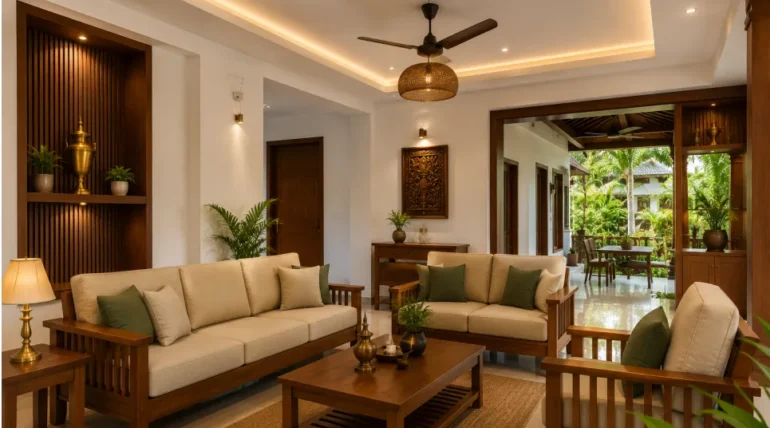
Here is what happens in most living rooms across Kerala. Someone picks a sofa they love in a showroom, brings it home, and then realizes it is two feet too wide for the space, or swallows the entire room, or looks oddly out of scale next to everything else. The sofa was not the problem. The selection process was long. Choosing the right Kerala sofa set designs is less about picking what looks good in isolation and more about understanding what actually works in your specific room, with your specific floor area, ceiling height, and how you actually use that space day to day.
This guide works through the decisions in the right order.
Table of Contents
How Kerala Sofa Set Designs Differ From Generic Catalogue Options
Kerala living rooms tend to have a specific character. Many homes here still feature warm wood tones in the flooring, doors, and window frames, whether traditional teak or contemporary laminates. The walls are often lighter, with off-whites or muted earth tones. And the living space frequently doubles as a guest receiving area, which changes how the furniture needs to function.
Generic catalogue sofas, designed for a broad national or international market, rarely account for this. They often come in configurations that prioritize visual impact over practical fit, and in materials or finishes that clash with the warmer palette common in Kerala interiors.
The sofa manufacturers in Malappuram and across Kerala who focus on custom builds understand these local conditions better than a mass-market showroom will. A customized piece can be sized to the room, finished in a fabric or upholstery that works with the existing tones, and built with a frame that is appropriate for the local climate, which is considerably more humid than northern India for much of the year.
Matching Sofa Configuration to Room Size
This is where most people make the first mistake. Configuration refers to the physical arrangement of the sofa pieces, not just the style. Getting this right is a spatial decision before it is an aesthetic one.
For rooms under approximately 150 square feet, a two-seater or compact three-seater with clean arms and a low backrest is almost always the better choice. Bulky sectionals or heavy-armed designs in a small room leave insufficient walkway space and make the room feel compressed. The general rule of thumb is to leave at least 90 centimetres of clear floor space between the front edge of the sofa and the nearest opposing furniture piece.
Medium-sized living rooms, roughly 150 to 250 square feet, can accommodate a standard three-seater plus a two-seater or pair of armchairs arranged facing each other. An L-shaped sectional also fits comfortably at this scale if the room layout supports it, particularly if one wall runs long enough to anchor the longer section without blocking walkways or door clearance.
Larger living rooms above 250 square feet have the most flexibility but also the most room for error. An undersized sofa set in a large room looks just as wrong as an oversized set in a small one. A U-shaped arrangement or a sectional combined with individual chairs tends to work best because it creates a defined conversation zone within a bigger open space.
Frame and Fill: What Actually Determines Comfort and Lifespan
Style decisions get most of the attention, but the internal construction of the sofa is what you will live with for the next ten to fifteen years.
The frame material is the foundation. Hardwood frames, including teak, rubberwood, and seasoned plantation timber, hold up better in Kerala’s humidity than engineered boards or softwood alternatives. A frame that absorbs moisture and warps over years becomes visible in how the sofa sits and how the upholstery wears.
Seat fill is the next consideration. High-density foam above 35 kilograms per cubic metre holds its shape noticeably longer than standard foam, which tends to compress and sag within a few years of regular use. Some custom builds combine a foam core with a top layer of fiber fill or feather down for a softer surface feel over a firmer base.
Fabric choice in a humid coastal and inland climate like Kerala’s should factor in breathability. Pure cotton and linen fabrics breathe better than synthetic blends and tend to feel cooler against skin through long monsoon months. For homes with children or pets, microfiber fabrics offer a practical balance of durability and ease of cleaning.
Thinking About Budget Without Cutting the Wrong Corners
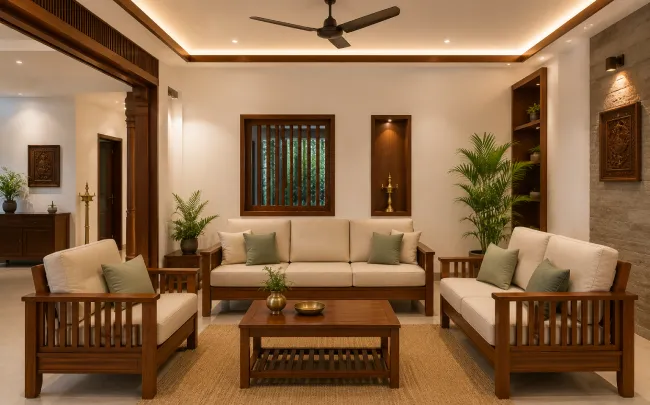
A sofa is a daily-use item for a room that most households treat as the heart of the house. Budget decisions made here have longer consequences than in almost any other furnishing category.
The most common budget mistake is spending heavily on the visible elements, fabric color, leg finish, and cushion count, while accepting compromises on the frame and foam. The aesthetic elements are what you see on day one. The structural elements are what you feel on day one thousand.
If working within a tighter budget, a simpler design with fewer decorative elements but a solid hardwood frame and good-quality foam will age better than an elaborate design built on cheaper materials. Sofa manufacturers in Malappuram who offer custom builds and show transparency around their material choices tend to be the more reliable choice for a longer-lasting result.
Sofa manufacturers in Malappuram who offer custom builds and show transparency around their material choices tend to be the more reliable choice for a longer-lasting result. BNG Interiors, one of the established interior designers in Malappuram, approaches sofa builds this way, with in-house manufacturing that keeps material decisions visible and accountable throughout the process.
Final Thoughts
Kerala sofa set designs that fit the room, suit the climate, and hold up over years of actual use are not products you find by browsing the most popular designs in a catalogue. It comes from starting with the right questions: How big is the space? How do people use it? What materials will perform in this climate? And where is the budget best spent?
FAQ
Most standard living rooms in Kerala fall between 150 and 200 square feet. A three-seater sofa in that space works well if you keep at least 90 centimetres of clear floor in front of it. If the room doubles as a guest area, a three-seater plus two armchairs or a compact two-seater gives you more seating flexibility without crowding the layout.
Cotton and linen are the most practical choices for Kerala’s humidity levels. They breathe better than synthetic fabrics and feel more comfortable through the warmer and wetter months. If durability is the bigger concern, high-quality microfiber holds up well to daily use and is considerably easier to clean than woven natural fabrics.
A well-built sofa with a hardwood frame and high-density foam should comfortably last ten to fifteen years with normal household use. The frame is the most important factor. Sofas that show early sagging or shape loss almost always have compromised frames or low-grade foam rather than fabric wear as the root cause.
It depends entirely on the room shape. L-shaped sofas need a corner wall configuration to sit correctly. If the room has an open layout without a strong corner to anchor against, an L-shaped sofa tends to float awkwardly in the space. They work best in rooms with a clear architectural corner and enough square footage to allow circulation on both open sides of the L.