
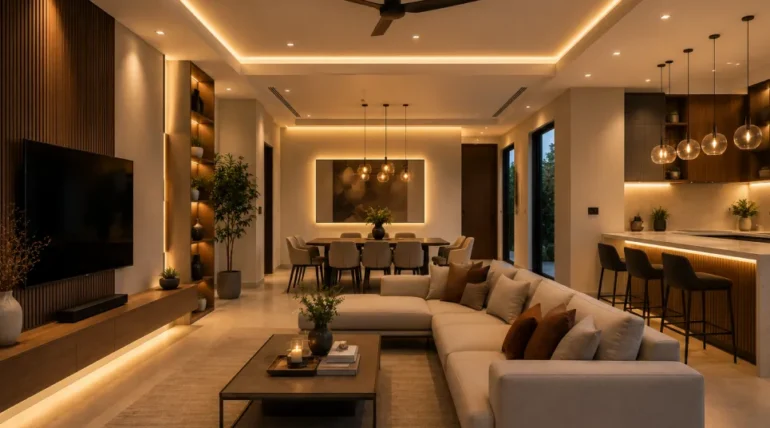
Most people plan their home’s lighting the same way they plan a backup plan. Right at the end, almost as an afterthought. The walls are painted, the furniture is placed, and then someone asks: where do the lights go? That approach is exactly why so many finished rooms feel flat, dim in the wrong places, or just a little off in a way that is hard to name. Interior modern lighting is not a finishing touch. It is the layer that determines how every other design decision reads in real life.
Homeowners across Malappuram are increasingly turning to professional help to get this balance right, and the interior designing services at BNG Interiors are built specifically around Kerala homes, local materials, and real budget constraints.
This guide walks through how to think about lighting room by room, what each space actually needs, and where most homes quietly get it wrong.
Table of Contents
How Interior Modern Lighting Works as a Layering System
Before getting room-specific, one concept is worth understanding: lighting works in layers, and each layer does a different job.
The first layer is ambient lighting. This is the base, the general illumination that fills a room. Recessed ceiling lights, surface-mounted panels, and cove lighting all fall here. Most rooms have only this layer, and that is where the problem starts.
The second layer is task lighting. This is directed, purposeful light positioned to help you do something specific. Reading, cooking, applying makeup, working at a desk. Task lighting sits closer to the surface being used.
The third layer is accent lighting. This is the one that makes a room feel designed rather than just lit. Wall-mounted picture lights, spotlights aimed at textured surfaces, and strip lighting behind shelving. Accent lighting creates depth and draws the eye to what is worth noticing.
A well-lit room uses all three. Most homes use only one. That gap is where interior designers in Malappuram tend to find the most room to improve a space.
Living Room: Where Lighting Flexibility Matters Most
The living room is the hardest room to light because it serves too many functions across the day. Morning coffee, afternoon reading, evening conversation, and watching a screen at night. No single light setting works for all of these.
The starting point is dimmable ambient lighting overhead. A central LED panel or a set of recessed downlights on a dimmer circuit gives you control over the base intensity.
From there, table lamps on either side of the sofa add warmth and bring the light source down from the ceiling to eye level, which makes a significant difference to how comfortable a room feels. Floor lamps near reading chairs handle task needs without hardwiring anything.
For accent work, consider uplighting behind plants or large furniture pieces or spotlights aimed at artwork or a textured feature wall.
The goal is to be able to run three or four different lighting combinations depending on what is happening in the room. That kind of flexibility cannot come from a single overhead fixture.
Kitchen: Task Lighting Is Non-Negotiable
Kitchens are where task lighting earns its importance most clearly. Overhead ambient light alone creates shadows directly over the counter wherever you are standing, because your own body blocks the ceiling source.
Under-cabinet lighting solves this. LED strip lights mounted beneath wall cabinets direct light exactly onto the work surface where you are preparing food. This is not a luxury addition. In a working kitchen, it is a practical necessity.
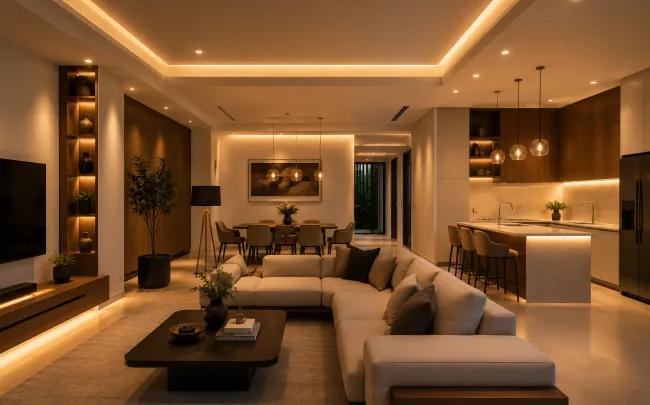
Pendant lights over a kitchen island or breakfast bar serve a dual purpose. They provide focused task light for that surface and also create a visual anchor that grounds the space. Pendant height matters: the standard recommendation is around 70 to 80 centimetres above the counter surface, though this adjusts for ceiling height.
Avoid cool, harsh white light in kitchens unless the space is very large. A warm white or neutral white tone tends to make food look more natural and the kitchen feel less clinical.
Bedroom: The Case for Layers Over Bright Overhead Light
The most common bedroom lighting mistake is a single bright ceiling fixture in the center of the room. That light is directly in your eyes when you are lying down, and it creates one flat plane of brightness that removes all shadow and texture from the space.
Bedrooms benefit from keeping the overhead ambient light soft and indirect. Cove lighting around a false ceiling perimeter, or a central fitting with a diffused shade, works better than a bare downlight panel.
Bedside task lighting is essential. Wall-mounted reading lights on adjustable arms keep the beam targeted and free up the bedside table. If wall mounting is not possible, table lamps with a switch at the base are the practical alternative.
Wardrobe interiors with interior strip lighting are often overlooked but make a real difference to usability, particularly in rooms that rely on natural light during the day but are used in the evening.
Bathroom: Avoiding the Single Overhead Problem
Bathrooms lit from a single overhead source create unflattering shadows on the face when standing at the mirror. The ceiling light hits the top of the head and creates dark areas under the eyes and chin.
Side-lit mirror lighting, either a backlit mirror or vertical fixtures on each side of the mirror, distributes light evenly across the face. This matters for practical tasks like shaving or applying makeup and also just makes the bathroom feel considered rather than provisional.
Waterproofing ratings for bathroom fixtures are not optional. Any fitting in a wet zone needs to carry an IP44 rating or higher, and fittings inside the shower enclosure require IP65 or above.
Final Thoughts
Interior modern lighting is the one design element that changes every other element in a room. The same furniture, the same paint, and the same layout read differently under three types of light. Getting the layers right is less about spending and more about thinking in the right sequence, from ambient to task to accent, in every room separately.
If you are currently planning or renovating a home in Kerala, what room do you think your current lighting gets most wrong?
FAQ
Ambient lighting is the general light that fills a room. Task lighting is focused on a specific surface where you need to see clearly, like a kitchen counter or a reading chair. Most rooms need both, but most homes only have the ambient layer installed.
A rough starting point for a living room is around 1,500 to 3,000 lumens total, depending on room size. But lumen count alone does not capture it. Distribution matters as much as total output, which is why multiple light sources at different heights almost always outperform a single high-lumen ceiling fitting.
For living areas and bedrooms, warm white (2700K to 3000K) tends to feel more comfortable and suits the warm material palette common in Kerala homes. Kitchens and bathrooms can handle neutral white (3500K to 4000K). Avoid cool daylight tones (5000K and above) in spaces where you spend extended time relaxing.
Experienced designers treat lighting as a structural decision, not a finishing one. They look at room function, ceiling height, furniture placement, and natural light availability before recommending fixture types or positions. The layering approach comes from mapping each activity that happens in a room and asking what light that activity needs.
Recessed downlights work well as ambient sources in kitchens and hallways. In living rooms and bedrooms, they need to be used carefully because they create a flat, uniform brightness that removes depth from the space. Combining them with lower-level lighting sources fixes this.