
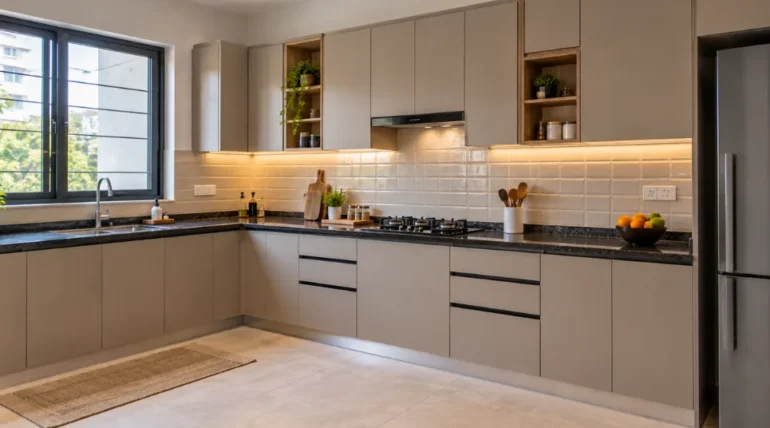
A modular kitchen makeover in Kerala rarely fails because of bad taste. It fails because the budget gets spent on finishes before anyone plans the low budget interior design of the layout itself, the part that decides whether the kitchen stays easy to cook in for the next fifteen years. Most homeowners start with laminate samples and cabinet colours. The smarter order is layout first, materials second, and decoration last.
That order matters more in a kitchen than in any other room. A living room forgives a wrong choice. A kitchen with a poorly placed chimney or a countertop that’s six inches too low does not.
Table of Contents
Low Budget Interior Design Starts With the Right Designer
Interior designers in Malappuram who handle kitchen work tend to treat the project as one connected system rather than a shopping list. BNG Interiors, for instance, lists interior designing, wood furniture, and sofa work under one services page rather than pricing the kitchen as a separate add-on. That structure tends to help on a tight budget, since the layout planning gets folded into the overall project scope instead of billed as a standalone consultancy fee.
Interior designing services in Malappuram generally start with a site visit to measure the kitchen triangle, the working distance between the stove, sink, and refrigerator. Getting that triangle right on paper costs nothing extra. Getting it wrong after the cabinets are installed costs a full redo.
Where the Real Savings Happen: Carcass, Shutters, and Countertop
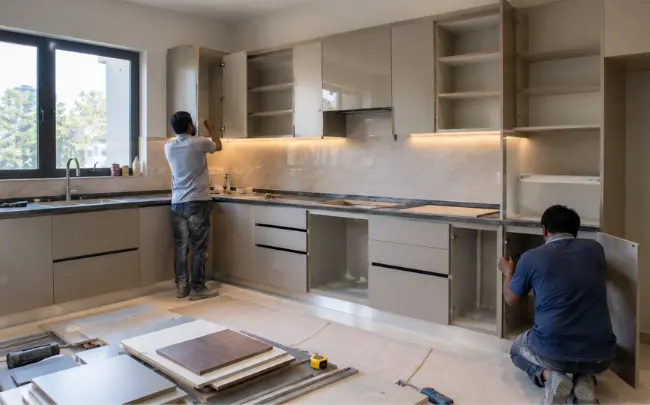
The carcass is the box behind the shutters, and it’s the one part nobody sees once the kitchen is finished. This is exactly where budget-conscious homeowners can save without any visible compromise. A BWR-grade plywood carcass, rather than a premium marine-grade one, is often sufficient for most Kerala kitchens as long as the joints are sealed properly. Under IS 303, the Bureau of Indian Standards classifies plywood by moisture resistance grade, and BWR plywood is built to withstand the steam and occasional spills a home kitchen produces, without the marine-grade price tag meant for boat hulls and outdoor decking.
Shutters are where most of the visible budget should go, since they’re touched daily and seen constantly. A laminate finish in a mid-range shade holds up better against oil stains than a high-gloss acrylic finish, and it costs considerably less per square foot. Save the acrylic or PU finish for one or two accent shutters instead of the entire kitchen run. That’s the practical shape of low budget interior design in a kitchen. Spend on what gets touched every day, save on what stays hidden behind a cabinet door.
Countertops eat budget fast if the material choice isn’t matched to how the kitchen actually gets used. Granite remains the most practical mid-budget option in Kerala’s climate. Quartz looks sharper but costs more and isn’t always necessary for a home kitchen that sees daily chopping and hot vessels.
Storage and Hardware Choices That Age Well
Hardware is the part people cut first and regret first. A soft-close hinge costs a little more per cabinet than a standard hinge, but it prevents the shutter sag that shows up within two years on cheaper hardware. Drawer channels matter just as much. Ball-bearing channels handle daily loading better than the basic telescopic type, especially in a kitchen that stores heavy vessels low and light items up top.
Vertical storage is the cheapest square footage in any kitchen. A tall pull-out unit next to the stove, instead of a row of lower cabinets alone, adds usable storage without adding to the built-up area, which is where a lot of the renovation cost gets calculated.
Lighting and Finishing Touches Without Overspending
Under-cabinet lighting along the countertop does more for daily usability than a decorative pendant light over the island, and it costs far less to install. A simple LED strip fixed under the wall units lights the actual work surface, which general ceiling lighting rarely reaches well enough for chopping or reading a recipe.
For the backsplash, a plain ceramic tile in a neutral tone, laid in a straight pattern rather than a herringbone or mosaic layout, keeps both material and labour costs down. Pattern and texture can always be added later through smaller, cheaper elements like a runner or open shelving, once the core kitchen is functional.
Final Thoughts
A modular kitchen doesn’t need every element upgraded to feel complete. It needs the daily-use parts built well and the decorative parts kept simple, at least for the first few years. Homeowners planning a renovation this season would do well to get a written breakdown of carcass grade, shutter finish, and hardware type before signing off on any quote, since that single document usually reveals where the actual budget is going. What part of your current kitchen frustrates you the most when you’re cooking?
FAQ
Costs vary widely based on kitchen length, material grade, and hardware choice, so there’s no single number that applies everywhere. A straight-line kitchen with BWR plywood and laminate shutters generally costs less than an L-shaped or island layout with acrylic finishes. Getting a written, itemised quote is the only reliable way to know your real number.
Yes, BWR plywood handles typical Kerala kitchen conditions well when the edges and joints are sealed properly during installation. Marine-grade plywood is built for constant water exposure, like boats or outdoor decking, which is more than a home kitchen actually needs. Spending extra there rarely improves daily performance.
Hardware, specifically hinges and drawer channels, is the one area where cheap choices show up fast. A shutter with a weak hinge starts sagging within a year or two of daily use. Spending slightly more here protects the rest of the kitchen investment.
Definitely. Keep the bulk of the kitchen in a simple laminate finish and reserve a premium acrylic or PU shutter for just one or two accent cabinets. Pattern and colour can also come from a tile backsplash or open shelving, which costs far less than upgrading every shutter.
Many local firms, including BNG Interiors, offer an initial site visit as part of the quoting process rather than charging separately for it. It’s worth confirming this directly with the firm before booking, since practices can differ between companies and change over time.